
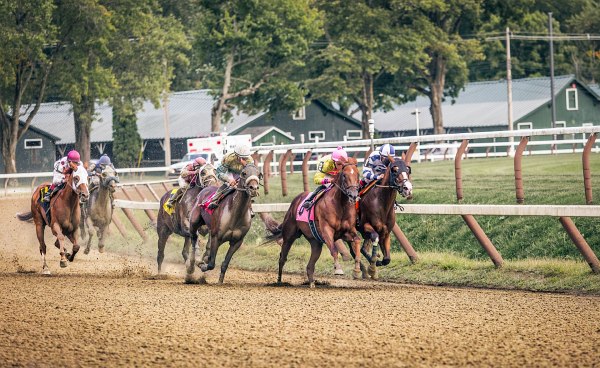
Santa Anita introduces two new ratings-based handicap races this Saturday, marking a significant shift in North American horse racing’s approach to race classification.
The card features a $35,000 handicap over 6 furlongs for dirt horses rated between 70-79 with seven entries, followed by a $65,000 handicap over 6 1/2 furlongs on the hillside turf course for fillies and mares rated 80-95 with six entries.
This national ratings system aims to provide racing secretaries with better tools for creating appropriate race conditions while giving connections of claiming-level horses options to run without risk of losing their horses.
Industry officials emphasize the system isn’t designed to replace claiming races, which remain the backbone of American racing.
While most major racing jurisdictions worldwide use ratings systems, North America appears to be pioneering an algorithmic approach rather than relying on human handicappers.
“It’s novel to my understanding,” said Chance Moquett, senior manager of strategic solutions at Equibase, the company behind the algorithm. “I believe it’s the only algorithmic rating of a population of racehorses in the world right now.”
Industry trust remains essential for the system’s success.
“There’s no right or wrong way. But the right way is one that works and people have confidence in,” veteran track executive Rick Hammerle told Steve Byk’s radio show last Thursday. “You’re only as good as the number.”
Moquett describes Saturday’s races as part of a soft launch designed for refinement over time.
“It’s not necessarily a polished thing at this point in time. We wanted to make sure that we are continuing to work on it, and that people understand that,” Moquett said.
“Feedback is important,” he added. “Feedback in any form is good feedback.”
Building the System
Development began in February with approximately 40-50 industry stakeholders divided into four cohort groups, resulting in about 50 formal meetings, according to Moquett.
These groups represented data science, competition (including trainers and track executives), handicapping and wagering, and international racing.
In April, racing secretaries from 12 different tracks sent Equibase batches of around 20 horses for rating evaluation.
Participating racing offices included Keeneland, Churchill Downs, Gulfstream Park, Maryland, Oaklawn Park, Sam Houston, Prairie Meadows, NYRA, Canterbury, Assiniboia Downs, Del Mar and Santa Anita.
“Then we would give back the ratings and ask, ‘how does this look? Does this look right?’ We worked with each one of those racing offices individually,” Moquett explained.
After several months of feedback, Equibase tested five years of historical data on a yearly basis.
“That means we took every horse and ran it through a ratings history process for each race,” said Moquett. “We basically re-ran every race for every horse for the calendar year 2020 forward, caught out any outliers.”
The testing revealed several issues requiring adjustment.
“We did correlation analysis between purse earnings versus what their figure was at any point in time, to make sure the horses that generally were earning more money were in line [ratings wise]. And we identified that our turf horses seemed to be rated a little bit higher at first,” Moquett said.
The team also discovered their initial ratings showed excessive volatility with surface switches and struggled to differentiate between good horses and elite performers.
The resulting system uses a multi-factor algorithm that assigns horses a numerical rating from 0-150 based on performance metrics, race class adjustments, surface and distance factors, track-specific variability, and recent form.
Horses must have at least two North American starts to receive a rating. The system updates daily to reflect ongoing race results, meaning a horse’s rating might change even without racing as its former competitors continue to run.
The formula consists of three main components, with the “performance score” serving as the foundation.
“This has a litany of other factors peppered into it, but in essence, it’s how fast did a horse run and how many lengths did it win or get beaten by,” Moquett explained.
The second component, “race strengths adjustments,” evaluates race class and field strength. The third factor, “track and distance adjustments,” incorporates track variance, bias, and post position data.
While the algorithm won’t be open-sourced due to its proprietary nature, Moquett said, “We welcome people to come under the hood, see what’s going on.”
The theoretical ceiling is 150, though Moquett noted, “I think the highest rating we had during the annual testings was Flightline, who was 136. That’s the highest it’s ever gotten.”
Moquett emphasized that a numerical rating differs from a speed figure.
“A speed figure looks largely at time components of a single race,” he said. “Whereas the Equibase rating takes the body of work in totality and grades aptitude.”
Individual racing jurisdictions will determine how ratings translate to weight assignments.
“This is not a handicapping tool, nor is it something that Equibase is trying to force on any institution,” Moquett clarified. “We do not know yet how close or competitive these things are going to be from a weight standpoint. We are intentionally leaving that to the racing offices and the racing secretaries to do as they see fit.”
The Numbers in Practice
Ratings for eligible horses are already displayed on their Equibase pages, with some assignments raising questions.
For example, dual Breeders’ Cup winner Rebel’s Romance (Dubawi), a leading middle-distance turf runner, carries a 90 rating. By comparison, four-year-old filly Antifona (Recoletos), entered in Saturday’s downhill turf handicap, is rated 95 despite being a stakes winner who hasn’t captured a graded stake in three attempts.
Moquett acknowledges limitations in the current system, noting “we are not very good yet at international play.” Additionally, Rebel’s Romance has made only one North American start this year.
“We reward consistent activity,” Moquett explained.
Antifona hasn’t raced in 2025, but the algorithm factors in frequency and quality of official workouts. Her busy work tab leading into her first start after a 14-month layoff influenced her rating.
“Her rating says this filly’s working and working well. The last time she ran she was fast. And so, that’s how this thing sees it,” Moquett said. “If she wins the race by five lengths, I’m going to feel like we did not do a good job.”
Another example involves top three-year-olds Sovereignty and Journalism, who have met twice with Journalism winning both encounters. Yet Journalism is rated 104 while Sovereignty sits at 103.
“The algorithm isn’t saying that Journalism is head and shoulders above Sovereignty. They’re relatively equally matched all things considered,” Moquett explained. “Our rating gives a little bit of extra credit for Journalism running against older horses in the Pacific Classic.”
He added, “What we’re saying is that we believe those two horses are relatively evenly matched within so many points.”
The most obvious discrepancies likely involve “fringe players on our rating system,” according to Moquett, who noted that development has focused primarily on horses most likely to fill races, typically at the lower end of the rating range.
Reactions from Santa Anita’s backstretch community have varied widely, with most adopting a wait-and-see approach.
“I’m not sure exactly how it’s going to work here yet,” said trainer Sean McCarthy. “But I don’t have an issue with it. It’s one way to keep onto a horse.”
Trainer John Sadler, who has Topalo (Tapiture) entered in the dirt handicap, said, “I don’t feel like so far I have a great understanding of it. We’re just feeling the water out. It’s interesting. But it doesn’t change the reality of California [a shrinking horse population].”
As for whether the system is truly ready for implementation, Moquett responded, “We’ll find out Saturday. I think there’s consensus in the industry that a new type of race and a new alternative to run horses is needed.”
“I would rather have something delivered and work through a soft launch with racing offices during a time of need—be able to better manage a horse population—than be able to say I can answer every question and defend every example that you bring me because I don’t know that we’d ever get to that.”

